STORAGE BATTERY Grid-Scale Battery Storage
Why Grid-Scale Battery Storage, Why Now?
- Policy targets of carbon neutrality by 2050 and a 46% reduction in GHG emissions by 2030
- The social challenge of renewable-energy output fluctuation and increasingly routine curtailment
- Completion of market framework development for the capacity market and balancing market (2024–2025)
- Connection-study applications surged 6-fold year on year—grid capacity is finite, creating a clear first-mover advantage
FY2024 connection-study applications
Approximately 6 times the previous year
What Is Grid-Scale Battery Storage?
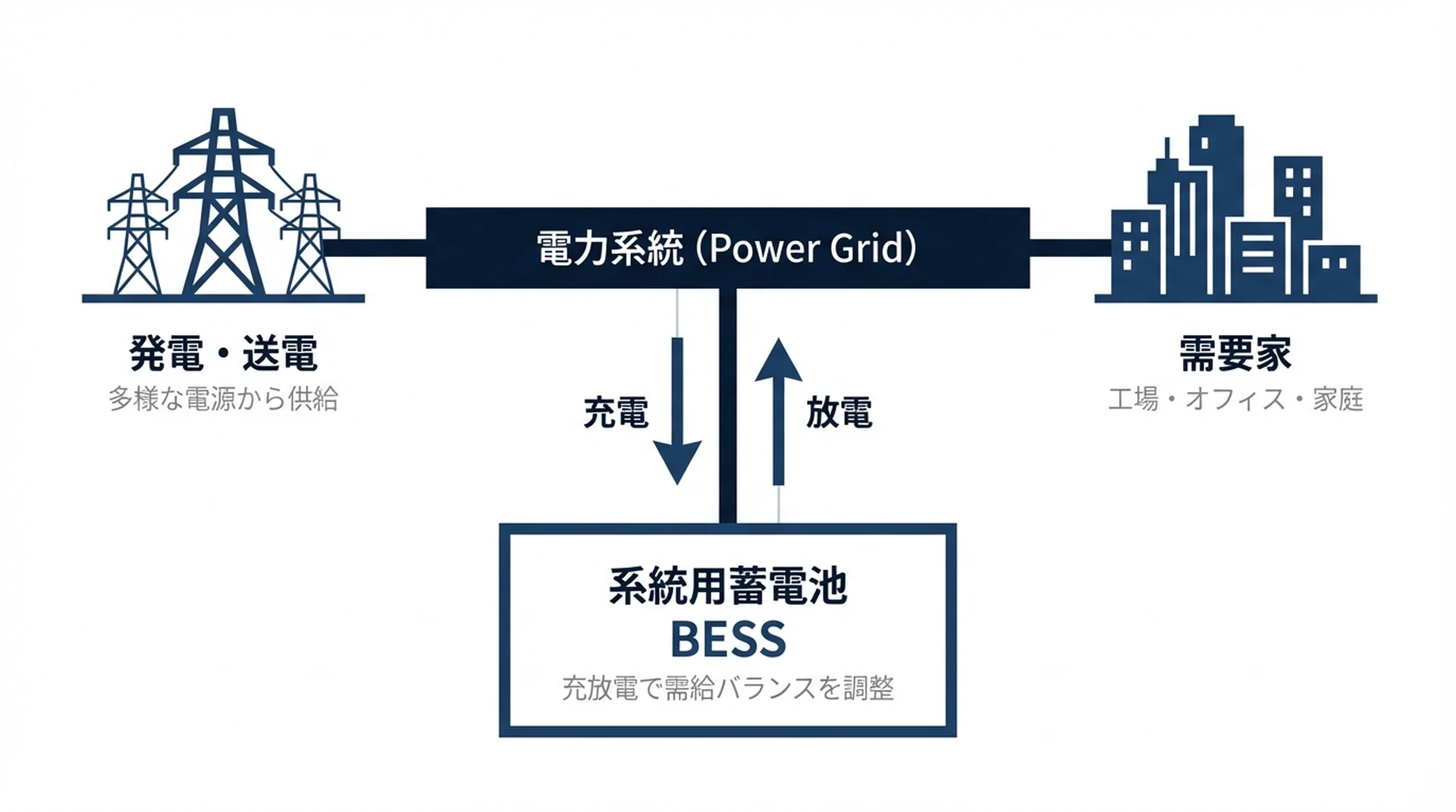
Next-generation infrastructure that connects directly to the power grid and generates returns through charging and discharging
Grid-scale battery storage is a large-scale battery system connected directly to the transmission and distribution network (the power grid). By charging when power is abundant and discharging when demand is tight, it balances electricity supply and demand. As renewable-energy deployment expands, battery storage is being promoted at the national-policy level as a key tool for grid stabilization, generating stable revenue through 3 market mechanisms: the capacity market, balancing market and power trading.
| Power Plant (Solar, Wind, etc.) | Grid-Scale Battery Storage | |
|---|---|---|
| Revenue Source | Electricity sales (FIT/FIP) | Capacity Market + Balancing Market + Power Trading |
| Revenue Stability | Dependent on weather and solar irradiance | Long-term capacity-market contracts secure base revenue |
| Impact on the Grid | Output fluctuation places a burden on the grid | Contributes to grid stabilization by providing balancing capacity |
| Policy Direction | FIT is shrinking; transitioning to FIP | The GX Promotion Act establishes expanded deployment as national policy |
| Siting Conditions | Constrained by solar irradiance and wind conditions | Greater location flexibility where grid-connection capacity is available |
3 Revenue Sources
Capacity Market (kW Value)
A market that pays for power-supply capability itself. Long-term contracts of up to 14 years can secure stable base revenue. The system recognizes value in the capacity to supply, even when no power is being generated.
Balancing Market (ΔkW Value)
A market for providing balancing capacity that maintains grid frequency and supply-demand balance. Battery storage responds quickly and is highly valued as balancing capacity. The market began full-scale operation in 2024, expanding new revenue opportunities.
Power Trading (kWh Value)
Arbitrage trading on the wholesale electricity market (JEPX). Charging when prices are low and discharging and selling when prices are high captures the spread; market-price volatility is the source of upside.
Business Flow
Opportunity Sourcing
Research and assess grid-connection capacity and sites. Select promising projects using our proprietary database.
Rights Securing
Acquire land and apply for grid connection. Submit a letter of intent in as little as 3 days.
Connection Study ResponseDesign and EPC Selection
Design the battery storage system, select the EPC contractor and execute the contract.
EPC AgreementConstruction
Construct and install battery storage equipment, with rigorous quality and schedule management.
Grid Interconnection
Complete interconnection procedures with the transmission and distribution utility, commissioning and required inspections.
Grid Interconnection AgreementStart of Operations
Participate in the capacity market, balancing market and power trading, supported by O&M for stable long-term operation.
Business Scheme
A transparent business scheme with clearly defined roles.
GRID CAPITAL coordinates every player as project manager.

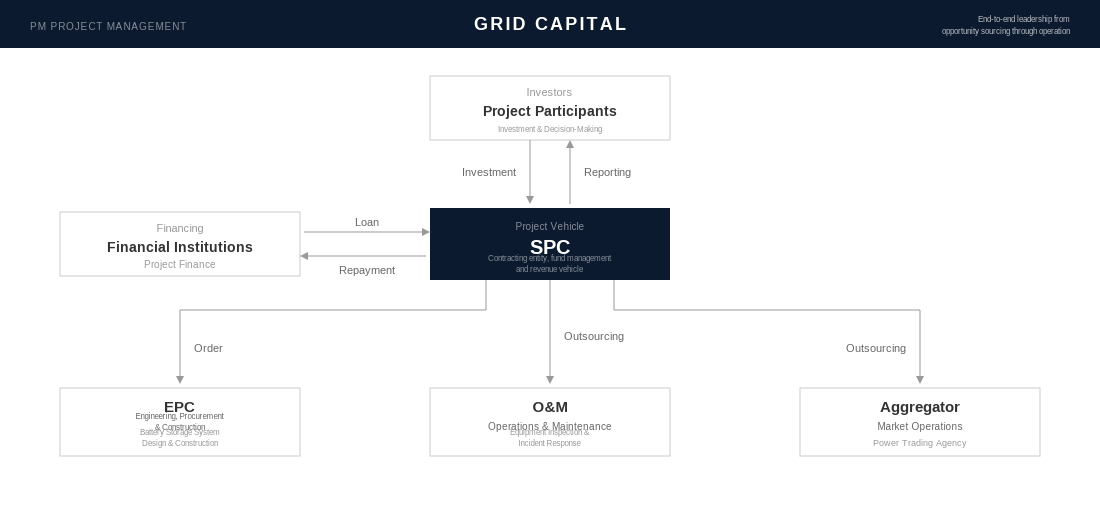
Risk Management
Power Market Risk
We lock in base revenue through long-term capacity-market contracts of up to 14 years. We position the balancing market and power trading as upside, using a portfolio strategy that minimizes the effects of market volatility.
Regulatory Change Risk
We continuously monitor changes in energy policy and market frameworks. Under the GX Promotion Act, battery storage is strongly promoted as national policy, and the favorable regulatory environment is expected to continue over the medium to long term.
Technology and Equipment Risk
We select established battery manufacturers and EPC contractors and manage quality from the design stage. 24-hour remote monitoring and regular inspections by O&M partners support stable long-term equipment operation.
Natural Disaster Risk
We hedge natural-disaster risk on multiple levels through detailed hazard-map review during site selection, rigorous earthquake- and wind-resistant design, and appropriate insurance coverage. We also develop contingency plans for BCP response.
Quality Policy (NO-GO Criteria)
Having standards for saying no is proof of integrity. We set out due-diligence criteria across 7 categories and do not handle projects whose quality cannot be assured.
Projects where landowner consent is unclear or the transfer of rights is restricted are NO-GO.
Projects with incomplete environmental assessment or material regulatory obstacles are NO-GO.
Projects with insufficient profitability or where financing is judged difficult to arrange are NO-GO.
Projects without approval for grid connection or with a prospect of significant delay are NO-GO.
Projects with high ground or disaster risk, or excessive site-development costs, are NO-GO.
Projects where the reliability of the EPC contractor, O&M provider or aggregator cannot be verified are NO-GO.
Projects suspected of involvement with antisocial forces or presenting compliance issues are NO-GO.
Project Status
Rights Secured
Land Lease AgreementApplication Complete
Connection Study ResponseContribution Paid
Construction Cost Contribution AgreementUnder Construction
Construction Progress ReportInterconnection Complete
Grid Interconnection Completion ReportOperations Started
Operating Performance ReportFrequently Asked Questions
15 to 20 years is typical. We also offer early-sale options.
We manage risk across 4 categories: regulatory change, technology, interconnection and operations. For details, please see the “Risks and Measures” section.
Solar power's main role is generation, while battery storage's is balancing. A key difference is that battery storage can earn revenue from multiple markets: capacity, balancing and power trading.
Yes. We have banking relationships with institutions including Sumitomo Mitsui Banking Corporation and Mizuho Bank, and support the structuring of project finance.
Multi-market operation avoids reliance on any one market. We adopt flexible operating strategies in response to market movements.
Our strongest differentiators are our ability to secure rights—submitting a letter of intent in as little as 3 days—and our transparency through disclosure of supporting documents throughout the process.